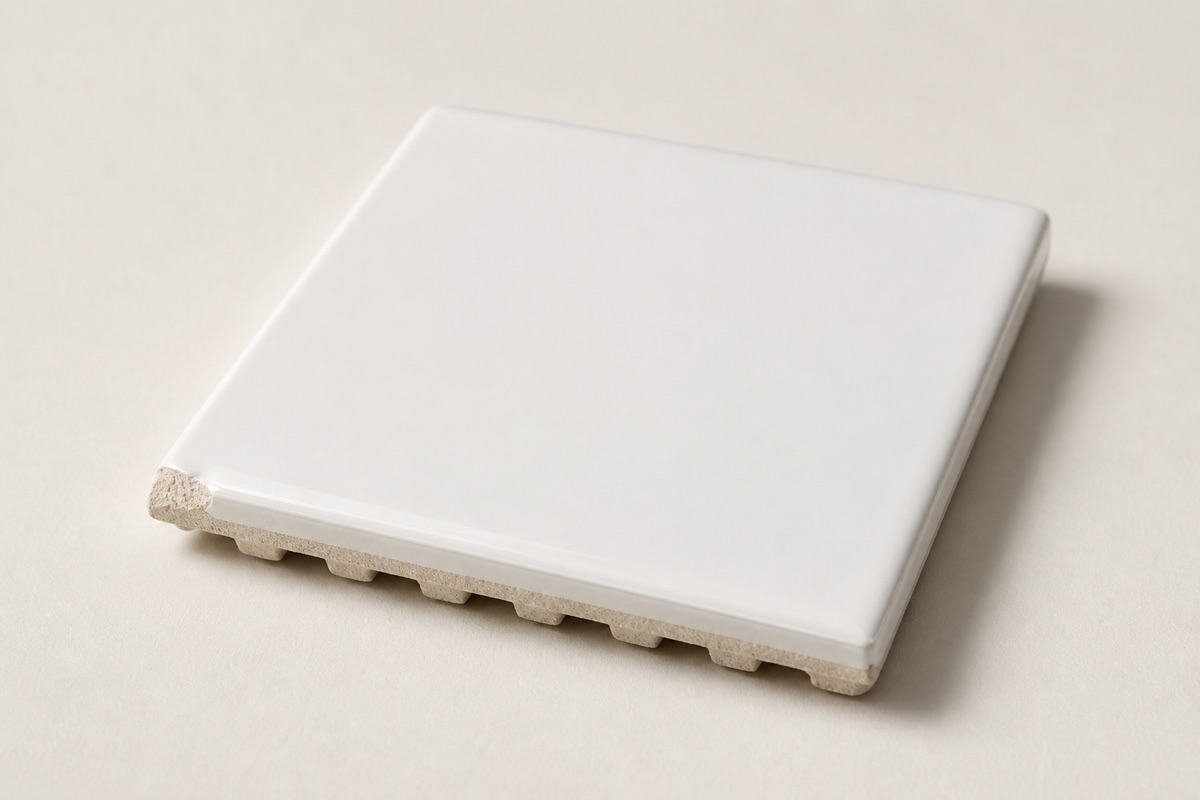
Material
Tile
Wall tile, floor tile, backsplash, porcelain tile
Default glue
A thick bead on the ridged back spans the gap between biscuit and wall, which is how a loose wall tile goes back on. It is a repair, not a mortar bed — floor tile and wet areas still want thinset.
Extra prep
- Scrape old mastic off the tile back and the wall until both are sound, dry, and free of dust. A crumbling wall is a masonry repair first.
Derived from our material compatibility data.
Identify
How to tell it’s tile
A thin, rigid square with a glossy glazed face and a ridged, unglazed back. A chip in the glaze shows a pale, grainy body, not the hollow of a mug or the thickness of a plate.
Character
What it’s like to glue
Two jobs that look the same and are not. Setting a tile back onto a wall wants a thick construction adhesive on the biscuit; mending a broken tile is the same clean-break problem as any other ceramic and still wants epoxy. Floor tile and wet areas are laid in thinset mortar, which is not a household adhesive — do not treat a cartridge as a substitute for a bed of mortar underfoot. Silicone seals grout and wet edges; it does not set a tile that has to stay put.
Properties
Why it glues the way it does
Why this answer
- Two jobs that look the same and are not. Setting a tile back onto a wall wants a thick construction adhesive on the biscuit; mending a broken tile is the same clean-break problem as any other ceramic and still wants epoxy. Floor tile and wet areas are laid in thinset mortar, which is not a household adhesive — do not treat a cartridge as a substitute for a bed of mortar underfoot. Silicone seals grout and wet edges; it does not set a tile that has to stay put.
- A thick bead on the ridged back spans the gap between biscuit and wall, which is how a loose wall tile goes back on. It is a repair, not a mortar bed — floor tile and wet areas still want thinset.
- Scrape old mastic off the tile back and the wall until both are sound, dry, and free of dust. A crumbling wall is a masonry repair first.
- PorositySemi-porous
- How much adhesive can soak in.
- Surface energyHigh
- Low surface energy sheds ordinary glue.
- StiffnessRigid
- Whether the joint has to bend with the part.
- Heat sensitivityLow
- How the material itself handles heat.
- Solvent sensitivityLow
- Whether solvent-based glues attack it.
Compatibility
Every glue family on tile
- Construction adhesiveWorks well
A thick bead on the ridged back spans the gap between biscuit and wall, which is how a loose wall tile goes back on. It is a repair, not a mortar bed — floor tile and wet areas still want thinset.
Extra prep: Scrape old mastic off the tile back and the wall until both are sound, dry, and free of dust. A crumbling wall is a masonry repair first.
- SiliconeDepends on conditions
It seals grout lines and wet edges. It does not set a tile that has to stay put underfoot or under a fixture.
- 2-part epoxyDepends on conditions
The answer for a broken tile, not a loose one: it fills a clean break in the ceramic body the same way it does a mug. A general-purpose epoxy is a poor setting bed.
- PolyurethaneDoesn’t hold
Polyurethane — it foams out from under the tile and leaves a ridge in the grout line, and it is not a mortar bed.
Near-invisible on a clean, tight break and set before you can fumble the piece — but brittle, and it softens in hot water.
Contact cement — the glaze gives its solvent nowhere to go, so the film stays soft and peels.
Spray adhesive — far too weak for a rigid part that gets handled and washed.
Fabric adhesive — it is made to stay soft inside a weave, and has no grip on glaze.
Wood glue — it shrinks as it dries and won't survive a sink of hot water.
Solvent cement — glaze and fired clay cannot be dissolved, so the solvent simply evaporates off the break.
Alternatives
Other glues that work on tile
It seals grout lines and wet edges. It does not set a tile that has to stay put underfoot or under a fixture.
The answer for a broken tile, not a loose one: it fills a clean break in the ceramic body the same way it does a mug. A general-purpose epoxy is a poor setting bed.
Near-invisible on a clean, tight break and set before you can fumble the piece — but brittle, and it softens in hot water.
Avoid
What not to use
Avoid
Polyurethane
Polyurethane — it foams out from under the tile and leaves a ridge in the grout line, and it is not a mortar bed.
Avoid
Contact cement
Contact cement — the glaze gives its solvent nowhere to go, so the film stays soft and peels.
Avoid
Spray adhesive
Spray adhesive — far too weak for a rigid part that gets handled and washed.
Avoid
Flexible fabric adhesive
Fabric adhesive — it is made to stay soft inside a weave, and has no grip on glaze.
Avoid
Wood glue (PVA)
Wood glue — it shrinks as it dries and won't survive a sink of hot water.
Avoid
Solvent cement
Solvent cement — glaze and fired clay cannot be dissolved, so the solvent simply evaporates off the break.
Projects
Common repairs with tile
Questions
Common questions
- Can I set floor tile with construction adhesive instead of thinset?
- Treat a cartridge as a repair for a single loose wall tile, not as a mortar bed. Floor tile and wet areas need a full bed of thinset so the load spreads and water has somewhere to go. A few beads under a floor tile leave hollows that crack the tile.
- How do I restick a loose tile in a shower?
- If the wall behind it is still sound and dry, scrape both faces clean and reset with a construction adhesive the maker documents for wet areas, then grout and seal. If the backer is soft or the leak is behind the wall, adhesive will not save it — that is a waterproofing repair.
- Should a cracked tile be glued or replaced?
- A tile that has come off in one piece can go back on. A tile cracked through its body is usually a replacement, because a glued crack in the glaze stays visible and the piece no longer takes foot traffic or thermal shock the way a whole tile does.
- Can I use silicone to stick a tile back on?
- Silicone is a seal, not a setting bed. It will hold a tiny, no-load accent in a dry spot and then let go under peel. Use it on grout lines and wet edges after the tile is set, not instead of setting adhesive.
- Do I have to remove the old mastic?
- Yes, wherever the new adhesive has to hold. Loose or oxidized mastic is a release layer: the new bead sticks to it and it lets go of the wall. Scrape to sound biscuit and sound wall, then dust off before you open the cartridge.