Material
MDF
Flat-pack furniture, cabinet doors, painted trim, speaker boxes
Default glue
It grips the fibre well on a face joint. On a cut edge the board drinks the first coat and swells if you flood it, so the edge needs sizing and the joint needs mechanical help.
Extra prep
- Size a cut edge with thinned glue, let it dry, then glue for real — and add a dowel or biscuit, because there is no grain for the joint to interlock with.
Derived from our material compatibility data.
Identify
How to tell it’s mdf
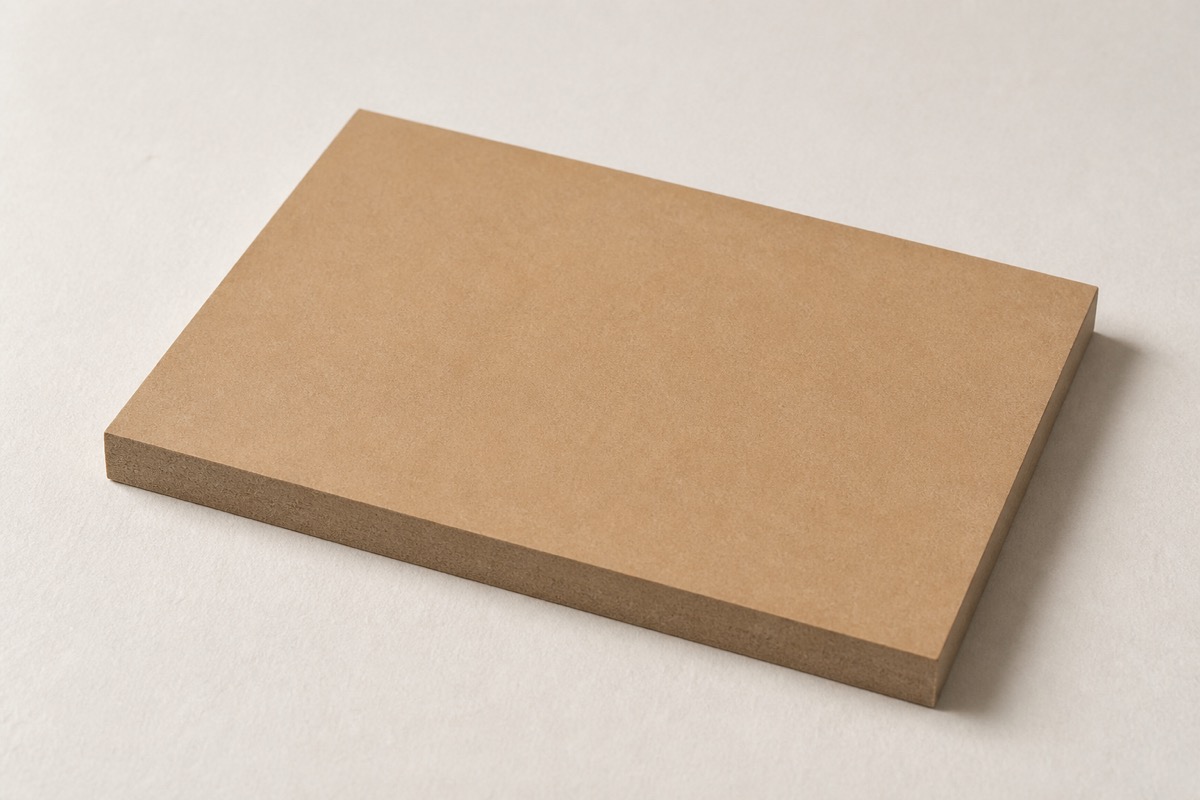
Heavy, perfectly flat board with no grain at all. A cut edge is uniform brown fibre that feels like dense cardboard, and the face is smoother than any real wood.
Character
What it’s like to glue
Wood fibre and glue pressed into a board, so it takes wood glue — but the two surfaces behave nothing alike. The compressed face is smooth and takes a thin, even glue line, while a cut edge is a sponge of loose fibre that drinks the glue and swells if you flood it. There is also no grain to interlock, so a plain butt joint has nothing but surface to hold, and water is the material's real enemy: once MDF swells it never goes back.
Properties
Why it glues the way it does
Why this answer
- Wood fibre and glue pressed into a board, so it takes wood glue — but the two surfaces behave nothing alike. The compressed face is smooth and takes a thin, even glue line, while a cut edge is a sponge of loose fibre that drinks the glue and swells if you flood it. There is also no grain to interlock, so a plain butt joint has nothing but surface to hold, and water is the material's real enemy: once MDF swells it never goes back.
- It grips the fibre well on a face joint. On a cut edge the board drinks the first coat and swells if you flood it, so the edge needs sizing and the joint needs mechanical help.
- Size a cut edge with thinned glue, let it dry, then glue for real — and add a dowel or biscuit, because there is no grain for the joint to interlock with.
- PorosityPorous
- How much adhesive can soak in.
- Surface energyMedium
- Low surface energy sheds ordinary glue.
- StiffnessRigid
- Whether the joint has to bend with the part.
- Heat sensitivityLow
- How the material itself handles heat.
- Solvent sensitivityLow
- Whether solvent-based glues attack it.
Compatibility
Every glue family on mdf
- Wood glue (PVA)Works well
It grips the fibre well on a face joint. On a cut edge the board drinks the first coat and swells if you flood it, so the edge needs sizing and the joint needs mechanical help.
Extra prep: Size a cut edge with thinned glue, let it dry, then glue for real — and add a dowel or biscuit, because there is no grain for the joint to interlock with.
- Contact cementWorks well
MDF's dead-flat face is the ideal substrate for laminate or veneer, and contact cement lays a sheet down over the whole area without a single clamp.
- PolyurethaneDepends on conditions
It foams into the loose fibre of a cut edge and grips where PVA gets absorbed, and it does not carry water into the board — but it expands, so clamp it and expect to trim the squeeze-out.
It bonds to surfaces wood glue cannot, and fills a gap instead of shrinking into one — the reason to reach past PVA on a loose joint or a mixed-material one.
A bead thick enough to span the gap between a board and an uneven wall — right for trim and panels, far too coarse for a furniture joint.
Bonds fine to bare wood and stays flexible, but it seals rather than joins — use it where the wood meets glass, tile, or a wet surface.
Only when the other side is cloth: it grips bare wood well enough for upholstery but has no strength as a wood joint.
Spray adhesive — it tacks paper and cloth to wood, but as a wood-to-wood joint it is a film that peels.
Super glue alone — it grabs wood, but cures brittle and bridges gaps poorly.
Solvent cement — it joins by dissolving plastic, and there is nothing in wood for it to dissolve, so it soaks in, evaporates, and leaves the joint dry.
Alternatives
Other glues that work on mdf
MDF's dead-flat face is the ideal substrate for laminate or veneer, and contact cement lays a sheet down over the whole area without a single clamp.
It foams into the loose fibre of a cut edge and grips where PVA gets absorbed, and it does not carry water into the board — but it expands, so clamp it and expect to trim the squeeze-out.
Better when: Gap or poor fit
It bonds to surfaces wood glue cannot, and fills a gap instead of shrinking into one — the reason to reach past PVA on a loose joint or a mixed-material one.
Better when: Gap or poor fit, Outdoor exposure
A bead thick enough to span the gap between a board and an uneven wall — right for trim and panels, far too coarse for a furniture joint.
Better when: Gap or poor fit
Bonds fine to bare wood and stays flexible, but it seals rather than joins — use it where the wood meets glass, tile, or a wet surface.
Better when: Water immersion, Flexing or movement
Only when the other side is cloth: it grips bare wood well enough for upholstery but has no strength as a wood joint.
Avoid
What not to use
Avoid
Spray adhesive
Spray adhesive — it tacks paper and cloth to wood, but as a wood-to-wood joint it is a film that peels.
Avoid
Super glue (CA)
Super glue alone — it grabs wood, but cures brittle and bridges gaps poorly.
Avoid
Solvent cement
Solvent cement — it joins by dissolving plastic, and there is nothing in wood for it to dissolve, so it soaks in, evaporates, and leaves the joint dry.
Questions
Common questions
- How do I glue an MDF edge so it actually holds?
- Seal the edge first with glue thinned enough to soak in, let it dry, then glue the joint normally. Without that step the board absorbs the glue and leaves a starved joint, and a flooded edge swells instead of bonding.
- Is glue alone enough for an MDF butt joint?
- Rarely. MDF has no grain to interlock, so a butt joint depends entirely on the glue film and the fibre right under it. Add dowels, biscuits, a screwed block, or a rabbet so the joint has something mechanical carrying the load.
- Can I glue a flat-pack furniture panel back together?
- Only if the fibre is still solid. Glue holds on clean fibre, but a blown-out screw hole or a crumbling edge has no material left to bond to. Pack a stripped hole with glue and a hardwood dowel, then redrill, rather than gluing the screw itself.
- Will waterproof glue make MDF water-resistant?
- No. The glue may survive but the board will not — MDF swells permanently once water reaches the fibre, and the swelling breaks the joint from the material's side. Use a moisture-resistant board or a different material anywhere damp.
- What sticks laminate or veneer to MDF?
- Contact cement, because MDF's face is flat enough to bond over its whole area and contact cement needs no clamps. Coat both surfaces, let them go tacky, align carefully since there is no second chance, then press the sheet down with a roller.