Material
EVA foam
Interlocking floor mats, yoga mats, shoe midsoles, cosplay armour, tool-case inserts
Default glue
Closed cells mean the solvent has nothing to collapse, so EVA gets the joint other foams cannot have: a seam that bends with the part and holds along its whole length. This is what shoe repairs and foam armour are built with.
Extra prep
- Scuff the glossy skin off both faces, coat them thinly, and wait until the cement is tacky rather than wet before pressing — it grabs where it first touches.
Derived from our material compatibility data.
Identify
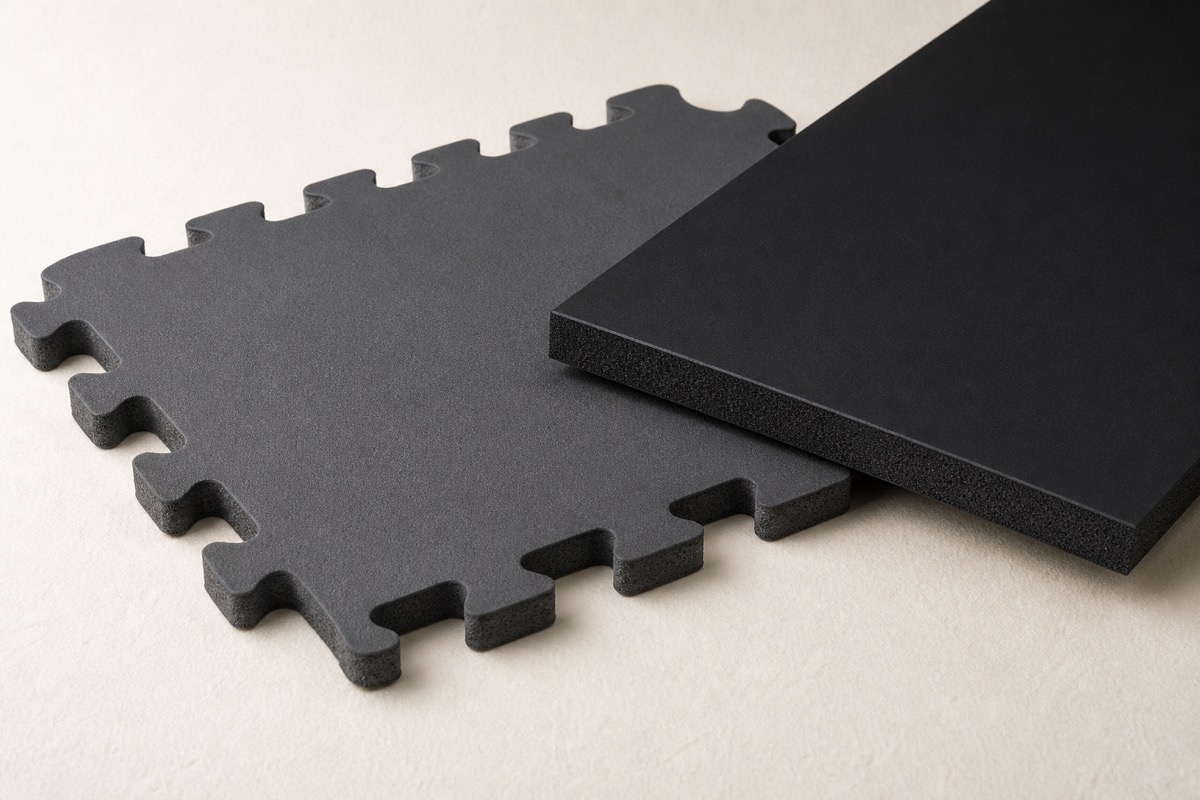
How to tell it’s eva foam
Dense, rubbery foam with a smooth skin and no visible bubbles until you cut it, and the cut face is closed and slightly waxy. It squashes and springs back like a shoe sole rather than crumbling like packing foam.
Character
What it’s like to glue
The foam that breaks the foam rules. Its cells are closed and it shrugs off the solvents that dissolve polystyrene, so the adhesives banned everywhere else on this site are the ones that work here — contact cement is the standard for shoe soles and cosplay armour alike. The catch is the smooth skin: it is slightly waxy and low-energy, so a scuff and a proper tacky-then-press routine matter more than the strength of the adhesive.
Properties
Why it glues the way it does
Why this answer
- The foam that breaks the foam rules. Its cells are closed and it shrugs off the solvents that dissolve polystyrene, so the adhesives banned everywhere else on this site are the ones that work here — contact cement is the standard for shoe soles and cosplay armour alike. The catch is the smooth skin: it is slightly waxy and low-energy, so a scuff and a proper tacky-then-press routine matter more than the strength of the adhesive.
- Closed cells mean the solvent has nothing to collapse, so EVA gets the joint other foams cannot have: a seam that bends with the part and holds along its whole length. This is what shoe repairs and foam armour are built with.
- Scuff the glossy skin off both faces, coat them thinly, and wait until the cement is tacky rather than wet before pressing — it grabs where it first touches.
- PorosityNon-porous
- How much adhesive can soak in.
- Surface energyLow
- Low surface energy sheds ordinary glue.
- StiffnessFlexible
- Whether the joint has to bend with the part.
- Heat sensitivityMedium
- How the material itself handles heat.
- Solvent sensitivityLow
- Whether solvent-based glues attack it.
Compatibility
Every glue family on eva foam
- Contact cementWorks well
Closed cells mean the solvent has nothing to collapse, so EVA gets the joint other foams cannot have: a seam that bends with the part and holds along its whole length. This is what shoe repairs and foam armour are built with.
Extra prep: Scuff the glossy skin off both faces, coat them thinly, and wait until the cement is tacky rather than wet before pressing — it grabs where it first touches.
- Super glue (CA)Depends on conditions
It tacks an EVA edge in seconds without the heat reaction that ruins polystyrene, which is why hobbyists use it to hold a seam while contact cement does the real work. On its own it stays a brittle line in a part that bends.
- Solvent cementDoesn’t hold
Solvent cement — EVA shrugs off these solvents rather than dissolving in them, so nothing softens, nothing welds, and the cement dries on the surface as a skin you can peel away.
No solvents, so it can't melt the foam.
Needs a specific product: 3M Foam Fast 74 Spray Adhesive
Water-based and foam-safe, but slow to dry inside a joint that holds no air.
Flexes with the foam and adds no solvents, though the bead stays visible.
Water-based and foam-safe, and it stays soft — the right pick for facing foam with cloth.
Solvent-free and waterproof, so the foam survives it — but the glue expands, so use a thin coat and weigh the parts down.
Only the foam-board grades work: a standard solvent-based tube dissolves polystyrene while it cures.
Extra prep: Check the tube for a foam-board or polystyrene rating, then test a scrap edge before committing to the whole panel.
Needs a specific product: Loctite PL 300 Foamboard Adhesive
Epoxy — it won't melt the foam, but it cures into a hard plate and the foam simply tears alongside it.
Alternatives
Other glues that work on eva foam
No solvents, so it can't melt the foam.
It tacks an EVA edge in seconds without the heat reaction that ruins polystyrene, which is why hobbyists use it to hold a seam while contact cement does the real work. On its own it stays a brittle line in a part that bends.
Water-based and foam-safe, but slow to dry inside a joint that holds no air.
Flexes with the foam and adds no solvents, though the bead stays visible.
Water-based and foam-safe, and it stays soft — the right pick for facing foam with cloth.
Solvent-free and waterproof, so the foam survives it — but the glue expands, so use a thin coat and weigh the parts down.
Better when: Outdoor exposure, Water immersion
Foam-board construction adhesive
Only the foam-board grades work: a standard solvent-based tube dissolves polystyrene while it cures.
Extra prep: Check the tube for a foam-board or polystyrene rating, then test a scrap edge before committing to the whole panel.
Avoid
What not to use
Avoid
Solvent cement
Solvent cement — EVA shrugs off these solvents rather than dissolving in them, so nothing softens, nothing welds, and the cement dries on the surface as a skin you can peel away.
Avoid
Epoxy
Epoxy — it won't melt the foam, but it cures into a hard plate and the foam simply tears alongside it.
Products
Products that suit eva foam
Questions
Common questions
- Why is contact cement fine on EVA when it destroys other foam?
- Solvent-based cement dissolves polystyrene because those cells are open and the plastic itself is attacked. EVA is closed-cell and resists the same solvents, so the cement stays on the surface and cures into a flexible seam instead of eating a hole.
- What holds cosplay foam armour together?
- Contact cement on both faces, left to go tacky, then pressed edge to edge — it bends with the piece and does not creep the way a hot-melt seam does. Bevel the mating edges first so they meet flat, because the joint is only as good as the contact area.
- Can I re-glue an EVA shoe midsole myself?
- Yes, and contact cement is what cobblers use. Scuff both faces, coat them, let them dry to tacky, then press hard and clamp or weight the shoe overnight — pressure across the whole area matters more than how much cement you use.
- Is hot glue good enough for EVA foam?
- It is fast and useful for tacking pieces while you work, but the bead stays a stiff ridge inside a flexible part, and it softens in a warm car or under stage lights. Use it to hold a piece in place, and let contact cement carry the seam.
- Do I need to sand EVA foam before gluing?
- Scuff the shiny skin wherever you can. That skin is smooth and slightly waxy, and it is the reason a bond peels off in one piece; a light abrasion gives the adhesive texture to hold. Wipe the dust away before coating.