Material
Drywall
Interior walls, ceilings, soffits
Default glue
A thick bead grips the paper face and spans the gaps behind trim or a light panel — the job this family is made for. The gypsum behind still has no peel strength, so a heavy fitting wants a stud.
Derived from our material compatibility data.
Identify
How to tell it’s drywall
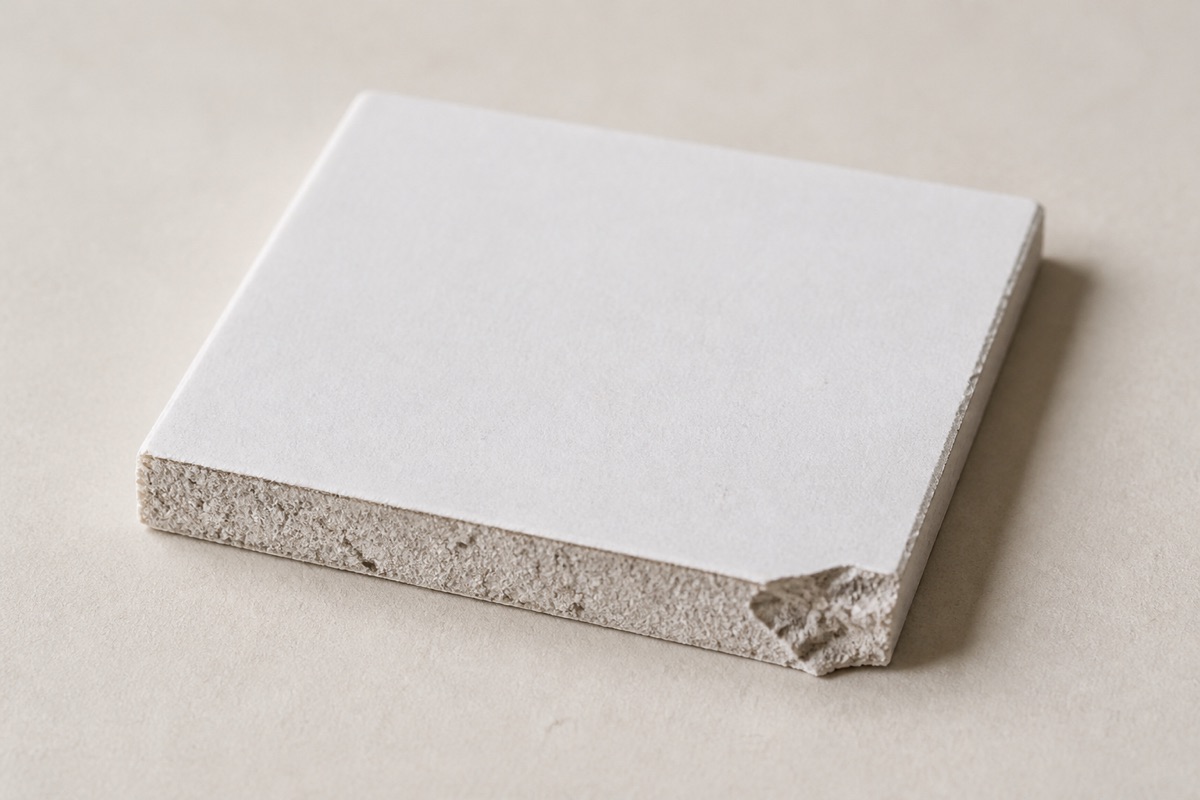
A paper face over a chalky gypsum core. The board is light for its size, a thumbnail crushes the core, and a cut edge shows the sandwich. Some boards are green or purple; the core is still gypsum.
Character
What it’s like to glue
You are gluing to paper, and the paper is glued to a core that has almost no strength in peel. Construction adhesive is the right family for trim and light panels; anything heavy, or anything that pulls straight off the wall, still wants an anchor into a stud. Joint compound is not an adhesive. Water ruins the core, so a wet bathroom wall is a different problem than a dry one.
Properties
Why it glues the way it does
Why this answer
- You are gluing to paper, and the paper is glued to a core that has almost no strength in peel. Construction adhesive is the right family for trim and light panels; anything heavy, or anything that pulls straight off the wall, still wants an anchor into a stud. Joint compound is not an adhesive. Water ruins the core, so a wet bathroom wall is a different problem than a dry one.
- A thick bead grips the paper face and spans the gaps behind trim or a light panel — the job this family is made for. The gypsum behind still has no peel strength, so a heavy fitting wants a stud.
- PorosityPorous
- How much adhesive can soak in.
- Surface energyHigh
- Low surface energy sheds ordinary glue.
- StiffnessRigid
- Whether the joint has to bend with the part.
- Heat sensitivityLow
- How the material itself handles heat.
- Solvent sensitivityMedium
- Whether solvent-based glues attack it.
Compatibility
Every glue family on drywall
- Construction adhesiveWorks well
A thick bead grips the paper face and spans the gaps behind trim or a light panel — the job this family is made for. The gypsum behind still has no peel strength, so a heavy fitting wants a stud.
- SiliconeDepends on conditions
The answer at a wet edge — around a tub, a sink, an expansion gap — where the joint has to seal and move rather than hold a panel on.
- Contact cementDepends on conditions
It will laminate a light sheet to a clean paper face over a whole area, but it has no gap-filling and no forgiveness if the paper lets go.
- EpoxyDoesn’t hold
Epoxy — it bonds the paper beautifully, and the paper then lets go of the gypsum, so the repair comes off in a sheet.
- PolyurethaneDoesn’t hold
Polyurethane — it foams, stains the paper, and the moisture it needs to cure also swells the gypsum core.
- Wood glue (PVA)Doesn’t hold
Wood glue — it soaks into the paper, has nothing thick enough to span a gap, and the water in it swells the core.
- Super glue (CA)Doesn’t hold
Super glue — it wicks into the paper and cures as a brittle crust that cracks off with the face.
- Spray adhesiveDoesn’t hold
Spray adhesive — a tack for a poster, not a bond; anything with weight walks the paper off the wall.
- Flexible fabric adhesiveDoesn’t hold
Fabric adhesive — too thin and too weak for a wall, and it was made to stay soft inside a weave.
- Solvent cementDoesn’t hold
Solvent cement — gypsum and paper do not dissolve, and the solvent wrinkles and stains the face on the way to nowhere.
Alternatives
Other glues that work on drywall
The answer at a wet edge — around a tub, a sink, an expansion gap — where the joint has to seal and move rather than hold a panel on.
Better when: Water immersion, Flexing or movement
It will laminate a light sheet to a clean paper face over a whole area, but it has no gap-filling and no forgiveness if the paper lets go.
Avoid
What not to use
Avoid
Epoxy
Epoxy — it bonds the paper beautifully, and the paper then lets go of the gypsum, so the repair comes off in a sheet.
Avoid
Polyurethane
Polyurethane — it foams, stains the paper, and the moisture it needs to cure also swells the gypsum core.
Avoid
Wood glue (PVA)
Wood glue — it soaks into the paper, has nothing thick enough to span a gap, and the water in it swells the core.
Avoid
Super glue (CA)
Super glue — it wicks into the paper and cures as a brittle crust that cracks off with the face.
Avoid
Spray adhesive
Spray adhesive — a tack for a poster, not a bond; anything with weight walks the paper off the wall.
Avoid
Flexible fabric adhesive
Fabric adhesive — too thin and too weak for a wall, and it was made to stay soft inside a weave.
Avoid
Solvent cement
Solvent cement — gypsum and paper do not dissolve, and the solvent wrinkles and stains the face on the way to nowhere.
Questions
Common questions
- Can I glue a TV, cabinet, or grab bar to drywall?
- No. Those loads pull straight off the wall, which is the direction the paper face is weakest. Use a mechanical anchor into a stud — or a rated hollow-wall anchor — and treat adhesive as a supplement for trim, not as the thing holding the weight.
- Is joint compound a glue?
- No. Joint compound fills and tapes a seam between boards; it has almost no peel strength once dry. Construction adhesive is what holds trim or a panel to the face. Do not use one for the other's job.
- Can I glue to painted drywall?
- Only if the paint is clean and firmly bonded. Glossy or peeling paint becomes the weak layer, and the repair comes off with the coating. Scrape or sand to sound paper — or to bare gypsum if the paper itself is loose — before applying adhesive.
- What if the drywall is in a bathroom?
- If the board is still sound and dry, construction adhesive still holds trim, and silicone is the right seal at wet edges. If the core is soft, stained, or crumbling, replace the board; no adhesive will stick to gypsum that has already taken on water.
- Do I need adhesive as well as nails for trim on drywall?
- Nails into studs hold the trim in place. Adhesive earns its keep between studs, on wavy walls, and anywhere a hollow cavity would let the board drum. On a flat, well-fastened wall, nails alone are often enough.