Material
Stainless steel
Sinks, appliances, railings, fasteners
Default glue
A strong rigid bond on degreased, evenly abraded stainless; a mirror finish must be roughened before the epoxy has a reliable surface to grip.
Extra prep
- Remove oil and polish, abrade to an even satin scratch, then clean again without touching the bond face.
Derived from our material compatibility data.
Identify
How to tell it’s stainless steel
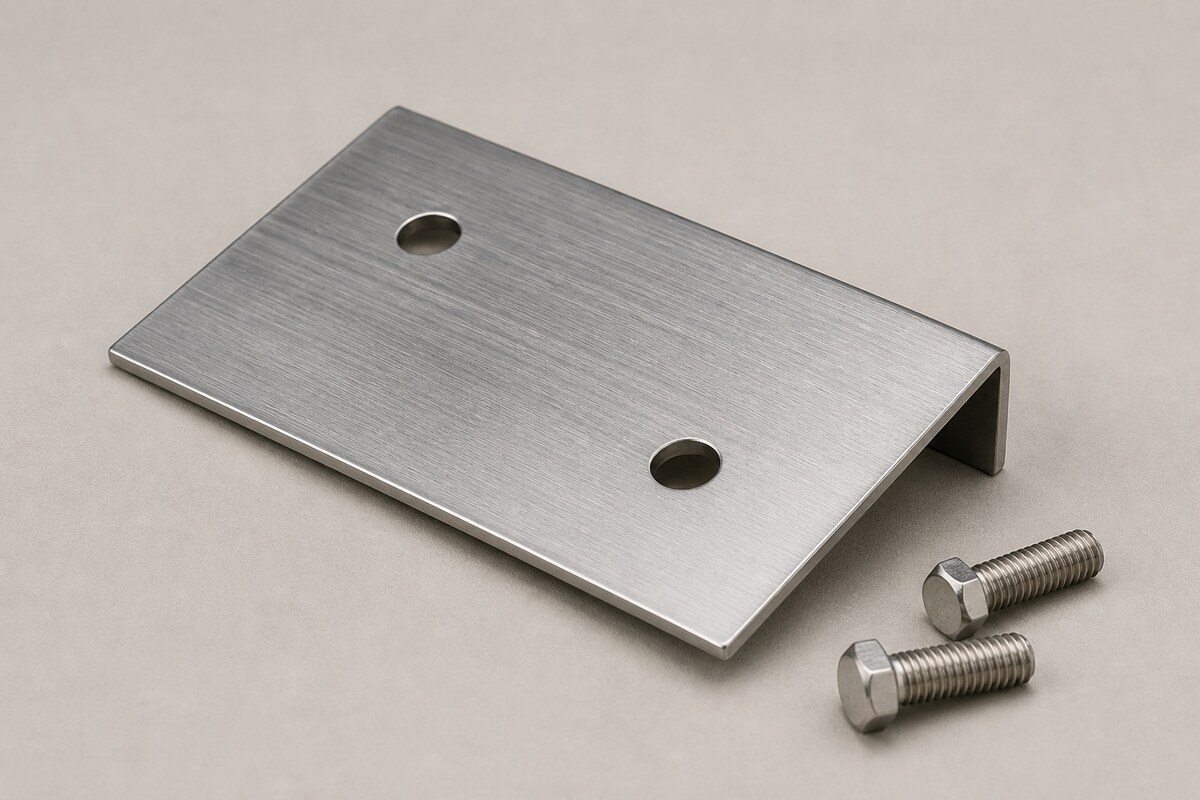
Silver-gray steel that resists rust. It may be brushed with fine straight lines or polished like a mirror; many common grades are weakly magnetic or not magnetic at all.
Character
What it’s like to glue
The passive chromium-oxide film is stable enough to bond, but fingerprints, polish, and a mirror finish leave little for adhesive to grip. Degrease, abrade to an even satin scratch, clean again, and keep fingers off the prepared face.
Properties
Why it glues the way it does
Why this answer
- The passive chromium-oxide film is stable enough to bond, but fingerprints, polish, and a mirror finish leave little for adhesive to grip. Degrease, abrade to an even satin scratch, clean again, and keep fingers off the prepared face.
- A strong rigid bond on degreased, evenly abraded stainless; a mirror finish must be roughened before the epoxy has a reliable surface to grip.
- Remove oil and polish, abrade to an even satin scratch, then clean again without touching the bond face.
- PorosityNon-porous
- How much adhesive can soak in.
- Surface energyHigh
- Low surface energy sheds ordinary glue.
- StiffnessRigid
- Whether the joint has to bend with the part.
- Heat sensitivityLow
- How the material itself handles heat.
- Solvent sensitivityLow
- Whether solvent-based glues attack it.
Compatibility
Every glue family on stainless steel
- 2-part epoxyWorks well
A strong rigid bond on degreased, evenly abraded stainless; a mirror finish must be roughened before the epoxy has a reliable surface to grip.
Extra prep: Remove oil and polish, abrade to an even satin scratch, then clean again without touching the bond face.
- Super glue (CA)Depends on conditions
Bonds a small, closely fitted stainless part quickly, but the cured joint is brittle and mirror-polished steel still needs abrasion.
Extra prep: Degrease the joint and break any mirror polish with a fine abrasive.
Waterproof and more forgiving of movement than epoxy, but it has no pores to foam into on this side — scuff the metal and clamp the joint.
For fixing a metal panel or trim across a wide area where a thick bead spans the hollows — not for a joint carrying its load through a small footprint.
Sticks well to clean metal and stays flexible and waterproof — a sealant around metal, not a joint that carries weight.
For facing metal with laminate, rubber, or leather over a wide area; degrease first, and expect it to soften if the metal gets hot.
Only when the other side is cloth, and only on degreased metal — it holds a lining, not a load.
Spray adhesive — the tacky film never hardens, so it creeps and slides on a smooth metal face.
Wood glue — it needs pores to soak into and peels straight off metal.
Solvent cement — it welds plastic by softening it, and metal never softens; the solvent flashes off and the parts come apart in your hands.
Alternatives
Other glues that work on stainless steel
Bonds a small, closely fitted stainless part quickly, but the cured joint is brittle and mirror-polished steel still needs abrasion.
Extra prep: Degrease the joint and break any mirror polish with a fine abrasive.
Waterproof and more forgiving of movement than epoxy, but it has no pores to foam into on this side — scuff the metal and clamp the joint.
For fixing a metal panel or trim across a wide area where a thick bead spans the hollows — not for a joint carrying its load through a small footprint.
Sticks well to clean metal and stays flexible and waterproof — a sealant around metal, not a joint that carries weight.
Better when: Water immersion, Flexing or movement
For facing metal with laminate, rubber, or leather over a wide area; degrease first, and expect it to soften if the metal gets hot.
Only when the other side is cloth, and only on degreased metal — it holds a lining, not a load.
Avoid
What not to use
Avoid
Spray adhesive
Spray adhesive — the tacky film never hardens, so it creeps and slides on a smooth metal face.
Avoid
Wood glue (PVA)
Wood glue — it needs pores to soak into and peels straight off metal.
Avoid
Solvent cement
Solvent cement — it welds plastic by softening it, and metal never softens; the solvent flashes off and the parts come apart in your hands.
Questions
Common questions
- Can I glue mirror-finish stainless steel?
- Yes, but the polish leaves very little texture for adhesive to grip. Remove any polish residue and roughen the hidden bond area to an even satin finish before gluing.
- How should I prepare stainless steel for glue?
- Remove oil and fingerprints, abrade the joint to a uniform dull scratch, then clean it again and let the cleaner evaporate. Keep your fingers off the prepared face and assemble soon after cleaning.
- Does a magnet prove that a part is stainless steel?
- No. Some stainless grades attract a magnet and others barely do, so magnetism can narrow the possibilities but cannot identify stainless by itself. Look at the finish, corrosion behavior, markings, and where the part is used as well.
- Does super glue stick to stainless steel?
- It does on a clean, closely fitted joint, especially when the polished face has been lightly abraded. Keep it to small rigid repairs because the cured adhesive is brittle and dislikes peel or impact.
- Can I glue a stainless-steel item used with food?
- Only if the exact adhesive is explicitly approved for that food-contact use and the joint design does not trap residue. A generic waterproof or food-safe claim does not automatically cover every repaired utensil, sink, or appliance part.