Material
PVC
Drain and supply pipe, exterior trim boards, fence and deck rail, conduit
Default glue
It softens both faces so the fitting and the pipe finish as a single piece — the only joint that holds pressure, and the strongest one on rigid PVC generally. It welds a seam, so it cannot rescue a gap.
Extra prep
- Cut square, deburr, and wipe both faces clean. Use the primer your plumbing code calls for, then push the joint fully home and hold it — a fitting can back itself out while the plastic is soft.
Not for: Gap or poor fit
Derived from our material compatibility data.
Identify
How to tell it’s pvc
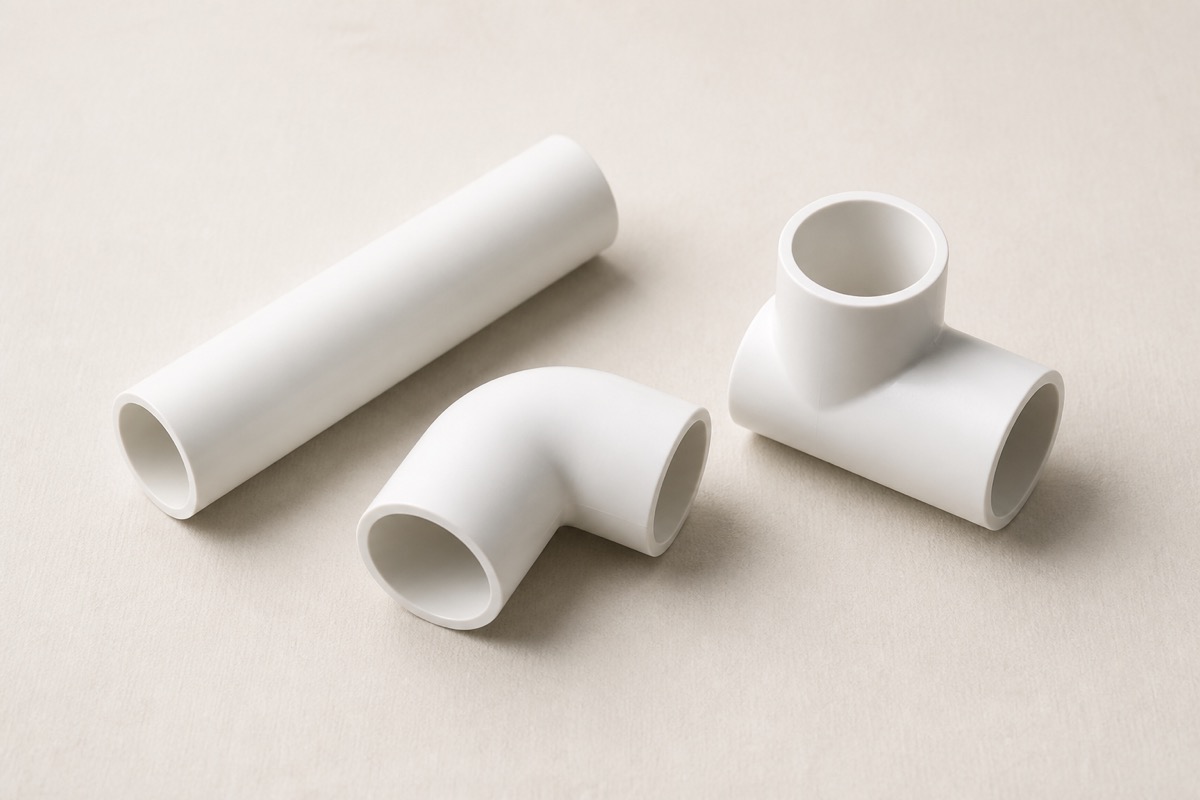
Usually white or grey, rigid, and printed along its length with a pipe spec or a brand name — that printing is the fastest way to confirm it. It feels harder and heavier than the plastic in household goods, and a cut edge stays white rather than turning grey.
Character
What it’s like to glue
The one common household plastic with a purpose-made welding solvent, and that changes the whole answer: for pipe, fittings, and any joint that has to hold pressure, PVC cement is not one option among several, it is the joint. Ordinary adhesives are for the cases cement cannot cover — bonding PVC to something that is not PVC, or closing a gap where the two faces do not meet.
Properties
Why it glues the way it does
Why this answer
- The one common household plastic with a purpose-made welding solvent, and that changes the whole answer: for pipe, fittings, and any joint that has to hold pressure, PVC cement is not one option among several, it is the joint. Ordinary adhesives are for the cases cement cannot cover — bonding PVC to something that is not PVC, or closing a gap where the two faces do not meet.
- It softens both faces so the fitting and the pipe finish as a single piece — the only joint that holds pressure, and the strongest one on rigid PVC generally. It welds a seam, so it cannot rescue a gap.
- Cut square, deburr, and wipe both faces clean. Use the primer your plumbing code calls for, then push the joint fully home and hold it — a fitting can back itself out while the plastic is soft.
- PorosityNon-porous
- How much adhesive can soak in.
- Surface energyMedium
- Low surface energy sheds ordinary glue.
- StiffnessRigid
- Whether the joint has to bend with the part.
- Heat sensitivityMedium
- How the material itself handles heat.
- Solvent sensitivityHigh
- Whether solvent-based glues attack it.
Compatibility
Every glue family on pvc
- PVC cementWorks well
It softens both faces so the fitting and the pipe finish as a single piece — the only joint that holds pressure, and the strongest one on rigid PVC generally. It welds a seam, so it cannot rescue a gap.
Extra prep: Cut square, deburr, and wipe both faces clean. Use the primer your plumbing code calls for, then push the joint fully home and hold it — a fitting can back itself out while the plastic is soft.
- 2-part plastic epoxyDepends on conditions
The answer once cement is out: it bonds PVC to materials that are not PVC, and it fills a broken or badly fitting joint that a weld would leave hollow. It is a repair, not a pressure joint.
Extra prep: Scuff the gloss off both faces and wipe away the dust and any pipe printing ink.
Instant on small, rigid, tight-fitting breaks — but it cures brittle and cracks loose on anything that flexes.
The fallback when the part flexes or gets wet; it seals rather than carries load.
For large panels like PVC trim, where a bead along the back is the point.
Waterproof and tough on scuffed rigid plastic, but it needs real clamping and the foam squeeze-out has to be trimmed.
Right for laminating a flexible plastic sheet down flat — but its solvent attacks polystyrene and ABS, so test a corner first.
Only when the other side is cloth: flexible enough for a fabric-to-plastic seam, far too weak for a structural one.
Spray adhesive — a repositionable film, not a bond; it slides off smooth plastic under any load.
Wood glue — plastic has no pores for it to soak into, so it peels off in a sheet.
Conditions
When the answer changes
Same joint, different circumstances. These are the conditions that change the pick.
Alternatives
Other glues that work on pvc
The answer once cement is out: it bonds PVC to materials that are not PVC, and it fills a broken or badly fitting joint that a weld would leave hollow. It is a repair, not a pressure joint.
Better when: Gap or poor fit
Extra prep: Scuff the gloss off both faces and wipe away the dust and any pipe printing ink.
Instant on small, rigid, tight-fitting breaks — but it cures brittle and cracks loose on anything that flexes.
The fallback when the part flexes or gets wet; it seals rather than carries load.
Better when: Flexing or movement, Water immersion
For large panels like PVC trim, where a bead along the back is the point.
Waterproof and tough on scuffed rigid plastic, but it needs real clamping and the foam squeeze-out has to be trimmed.
Better when: Outdoor exposure, Water immersion
Right for laminating a flexible plastic sheet down flat — but its solvent attacks polystyrene and ABS, so test a corner first.
Only when the other side is cloth: flexible enough for a fabric-to-plastic seam, far too weak for a structural one.
Avoid
What not to use
Avoid
Spray adhesive
Spray adhesive — a repositionable film, not a bond; it slides off smooth plastic under any load.
Avoid
Wood glue (PVA)
Wood glue — plastic has no pores for it to soak into, so it peels off in a sheet.
Questions
Common questions
- Can I fix a PVC pipe with epoxy or super glue?
- Not as a pressure joint. Those adhesives sit on the surface, while PVC cement welds the pipe and fitting into one piece — that is what holds against water pressure. Epoxy is for a repair that will never be pressurised, or for joining PVC to something that is not PVC.
- Can I use PVC cement on ABS pipe, or join the two?
- Each plastic needs its own cement, and a PVC-to-ABS joint needs a transition cement made for that pair — or, in many jurisdictions, a mechanical coupling instead. Check your local plumbing code before cementing dissimilar drain pipe, because inspectors look for exactly this.
- Do I have to use purple primer on PVC?
- For pressure pipe, plumbing codes commonly require it, and the colour exists so an inspector can see it was used. The primer cleans and pre-softens the surfaces, which is why a primed joint is more reliable even where it is not mandatory.
- What glue holds PVC trim board?
- PVC trim manufacturers specify a cement or trim adhesive made for cellular PVC, not ordinary wood or panel adhesive. Trim also moves a lot with temperature, so the fastening schedule and the gaps the manufacturer specifies matter as much as the adhesive.
- Does PVC cement work on soft vinyl?
- Not reliably. Flexible vinyl is loaded with plasticiser, so a rigid weld cracks along the joint as the material moves, and the plasticiser can migrate into the adhesive and soften it. Use a vinyl or flexible plastic adhesive on soft sheeting, hose, and fabric-backed vinyl.