Material
Acrylic
Display cases, picture glazing, shelf brackets, sign faces, storm windows
Default glue
Run into the seam by capillary action, it welds the two edges into one piece and leaves a joint you can see through — the only method that keeps a clear part clear.
Extra prep
- Peel the protective film back only at the joint, make sure both edges are flat and touching along their whole length, and hold the parts square in a jig or with tape while the seam sets.
Not for: Gap or poor fit
Derived from our material compatibility data.
Identify
How to tell it’s acrylic
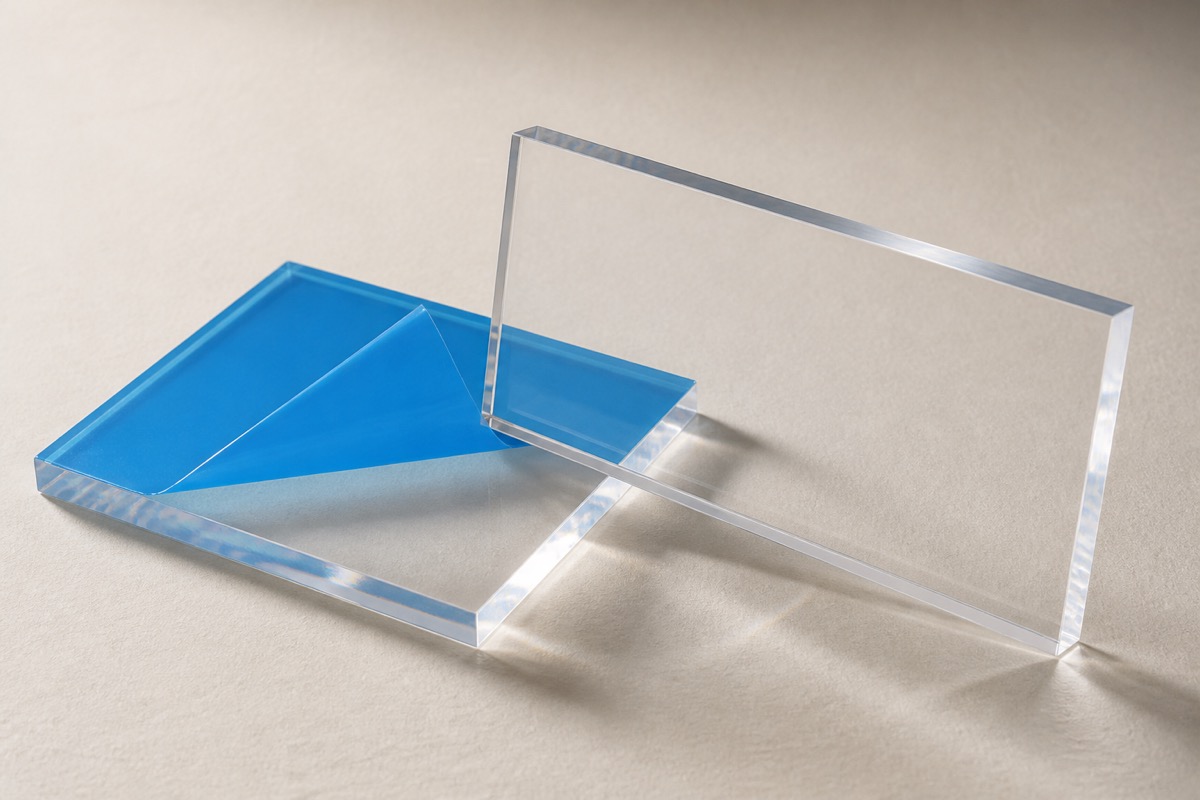
Clear, glassy, and lighter than glass, usually with a protective film still on the sheet when new. It sounds duller than glass when tapped, scratches easily, and a sharp blow cracks it rather than shattering it into fragments.
Character
What it’s like to glue
The only material here where how the joint looks is part of whether it works, because you can see straight through it. Acrylic dissolves in the right solvent, so two clean edges can be welded into a seam that is nearly invisible. The same sensitivity is the hazard: super glue vapour, solvent-based adhesives, and household cleaners all fog or craze the surface with a web of tiny cracks, often nowhere near where you applied them.
Properties
Why it glues the way it does
Why this answer
- The only material here where how the joint looks is part of whether it works, because you can see straight through it. Acrylic dissolves in the right solvent, so two clean edges can be welded into a seam that is nearly invisible. The same sensitivity is the hazard: super glue vapour, solvent-based adhesives, and household cleaners all fog or craze the surface with a web of tiny cracks, often nowhere near where you applied them.
- Run into the seam by capillary action, it welds the two edges into one piece and leaves a joint you can see through — the only method that keeps a clear part clear.
- Peel the protective film back only at the joint, make sure both edges are flat and touching along their whole length, and hold the parts square in a jig or with tape while the seam sets.
- PorosityNon-porous
- How much adhesive can soak in.
- Surface energyMedium
- Low surface energy sheds ordinary glue.
- StiffnessRigid
- Whether the joint has to bend with the part.
- Heat sensitivityMedium
- How the material itself handles heat.
- Solvent sensitivityHigh
- Whether solvent-based glues attack it.
Compatibility
Every glue family on acrylic
- Acrylic cementWorks well
Run into the seam by capillary action, it welds the two edges into one piece and leaves a joint you can see through — the only method that keeps a clear part clear.
Extra prep: Peel the protective film back only at the joint, make sure both edges are flat and touching along their whole length, and hold the parts square in a jig or with tape while the seam sets.
- Clear 2-part epoxyDepends on conditions
The choice when the fit is bad or the other side is not acrylic. It fills what a weld cannot close, but the glue line stays visible and a general-purpose epoxy can yellow in sunlight.
- Super glue (CA)Depends on conditions
It bonds acrylic quickly, but the vapour blooms white across the surrounding surface and the cured joint can craze the sheet — acceptable on a hidden fixing, not on anything you look through.
- Contact cementDoesn’t hold
Contact cement — its solvent attacks acrylic on contact, leaving a cloudy, crazed patch that no amount of polishing brings back.
The fallback when the part flexes or gets wet; it seals rather than carries load.
For large panels like PVC trim, where a bead along the back is the point.
Waterproof and tough on scuffed rigid plastic, but it needs real clamping and the foam squeeze-out has to be trimmed.
Only when the other side is cloth: flexible enough for a fabric-to-plastic seam, far too weak for a structural one.
Spray adhesive — a repositionable film, not a bond; it slides off smooth plastic under any load.
Wood glue — plastic has no pores for it to soak into, so it peels off in a sheet.
Conditions
When the answer changes
Same joint, different circumstances. These are the conditions that change the pick.
Alternatives
Other glues that work on acrylic
The choice when the fit is bad or the other side is not acrylic. It fills what a weld cannot close, but the glue line stays visible and a general-purpose epoxy can yellow in sunlight.
Better when: Gap or poor fit
It bonds acrylic quickly, but the vapour blooms white across the surrounding surface and the cured joint can craze the sheet — acceptable on a hidden fixing, not on anything you look through.
The fallback when the part flexes or gets wet; it seals rather than carries load.
Better when: Flexing or movement, Water immersion
For large panels like PVC trim, where a bead along the back is the point.
Waterproof and tough on scuffed rigid plastic, but it needs real clamping and the foam squeeze-out has to be trimmed.
Better when: Outdoor exposure, Water immersion
Only when the other side is cloth: flexible enough for a fabric-to-plastic seam, far too weak for a structural one.
Avoid
What not to use
Avoid
Contact cement
Contact cement — its solvent attacks acrylic on contact, leaving a cloudy, crazed patch that no amount of polishing brings back.
Avoid
Spray adhesive
Spray adhesive — a repositionable film, not a bond; it slides off smooth plastic under any load.
Avoid
Wood glue (PVA)
Wood glue — plastic has no pores for it to soak into, so it peels off in a sheet.
Questions
Common questions
- Why did super glue leave a white haze on my acrylic?
- The vapour given off while cyanoacrylate cures settles on the surrounding surface as a white bloom, and it lands wherever the vapour reaches, not only on the joint. On a clear part, use acrylic cement instead, or a low-odour cyanoacrylate with plenty of ventilation.
- How do I get an invisible joint in acrylic?
- Use acrylic cement on edges that are flat and touching along their full length, and let capillary action pull it into the seam rather than spreading it. Any gap shows as a line or a bubble, so the fit of the edges matters more than the cement.
- What causes those tiny cracks in acrylic near a repair?
- That is crazing: solvent attacking the surface while the part is under stress. Over-tight clamping, a forced fit, and solvent-based adhesives or cleaners all bring it on, and it appears near stressed areas rather than at the point of contact. Relieve the stress and keep stray solvent off the sheet.
- How do I tell acrylic from polycarbonate before gluing?
- Acrylic is stiffer, more brittle, and cracks under a sharp blow; polycarbonate flexes and takes the hit. If a hidden offcut cracks cleanly it is likely acrylic. It matters because acrylic cement welds acrylic properly, while the same solvents can leave polycarbonate stress-cracked.
- How do I glue acrylic to wood or metal?
- Cement cannot help here, since there is nothing to dissolve on the other side. Use a clear epoxy, and remember the two materials expand at different rates — on anything large, a flexible sealant or a mechanical fixing will outlast a rigid glue line.