Guide
Mount a frameless bathroom mirror to drywall or tile safely
Use dedicated solvent-free mirror mastic or 100% neutral-cure silicone to mount frameless mirrors to drywall or tile. Standard construction adhesives and acidic (acetoxy) silicones eat through reflective silver backing within months, leaving permanent black clusters.
This task involves: Load-bearing / shear, Visible glue line
Best Glue for This Repair
Dedicated solvent-free mirror mastic
Specially formulated without aggressive solvents to support heavy vertical glass weight without chemically corroding the reflective silver backing.
Extra prep
- Scrape old mastic off the tile back and the wall until both are sound, dry, and free of dust. A crumbling wall is a masonry repair first.
Not for: Visible glue line
Reviewed and adjusted by an editor.
Why Dedicated solvent-free mirror mastic Works Here
- Non-porous and unforgiving — any grease film or fingerprint weakens the joint and stays visible through the glass forever.
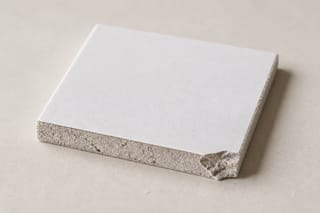
- You are gluing to paper, and the paper is glued to a core that has almost no strength in peel. Construction adhesive is the right family for trim and light panels; anything heavy, or anything that pulls straight off the wall, still wants an anchor into a stud. Joint compound is not an adhesive. Water ruins the core, so a wet bathroom wall is a different problem than a dry one.
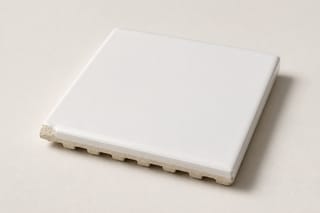
- Two jobs that look the same and are not. Setting a tile back onto a wall wants a thick construction adhesive on the biscuit; mending a broken tile is the same clean-break problem as any other ceramic and still wants epoxy. Floor tile and wet areas are laid in thinset mortar, which is not a household adhesive — do not treat a cartridge as a substitute for a bed of mortar underfoot. Silicone seals grout and wet edges; it does not set a tile that has to stay put.
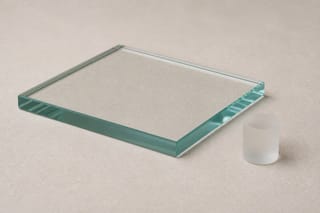
- Only for hanging a mirror or glass panel on a wall, and only with a mirror-rated tube — ordinary solvent formulas eat the silver backing.
- A thick bead grips the paper face and spans the gaps behind trim or a light panel — the job this family is made for. The gypsum behind still has no peel strength, so a heavy fitting wants a stud.
- A thick bead on the ridged back spans the gap between biscuit and wall, which is how a loose wall tile goes back on. It is a repair, not a mortar bed — floor tile and wet areas still want thinset.
- Scrape old mastic off the tile back and the wall until both are sound, dry, and free of dust. A crumbling wall is a masonry repair first.
How to do it
Mount a frameless bathroom mirror to drywall or tile safely: Step by Step
- Inspect the painted rear surface of the mirror to ensure backing coatings are free of deep scratches or bare glass exposure.
- Measure and mark the mirror perimeter on the drywall or tile wall using a level and blue painter tape.
- Screw a temporary straight wooden ledger board into wall studs (or install a permanent bottom J-channel) to carry vertical glass weight during adhesive cure.
- Apply vertical beads of mirror mastic 5–6 inches apart on the mirror back, keeping beads at least 3 inches away from outer edges to prevent squeeze-out.
- Rest the mirror bottom onto the support ledge, press the face firmly against the wall to flatten mastic beads, and secure the top with heavy tape for 48 hours.
Conditions
When to Use Neutral-cure 100% silicone (non-acetoxy) Instead
Large frameless mirrors weigh 20–50+ lbs and lack protective frames. Using solvent-heavy glues chemically destroys the reflective silver coating, while using glues with low tensile green strength causes the mirror to slide off the wall.
Alternatives
Other Adhesives That Work
Neutral-cure 100% silicone (non-acetoxy)
Safe on mirror silver backing and waterproof for humid bathrooms, but requires mechanical bottom ledger support during cure.
Better when: Flexing or movement, Water immersion
Avoid
Glues to Avoid for This Repair
Avoid
Standard super glue
Cyanoacrylate vapors degrade mirror backing paint and ultra-fast cure provides zero working time to adjust heavy glass alignment.
Questions
Common Questions About This Repair
- Why does standard construction adhesive destroy mirror backing?
- Standard solvent-based construction adhesives and acetoxy (vinegar-smelling) silicones release acetic acid and aromatic solvents that dissolve the protective paint and chemically oxidize the reflective silver layer, turning it into opaque black corrosion clusters.
- Why must mirror adhesive beads be applied in vertical lines only?
- Vertical lines allow air to circulate freely behind the mirror so the adhesive can cure evenly, and prevent moisture from getting trapped behind horizontal dammed ridges in humid bathrooms.
- Why is a temporary bottom support ledge mandatory when gluing mirrors?
- Mirror mastic remains wet and pliable for the first 12–24 hours. Without a solid mechanical ledge screwed to studs beneath it, gravity will cause the heavy mirror to slowly slide down the wall.
- How long must the support bracket stay in place after installation?
- Keep the bottom support ledge and top safety tape in place for at least 48 hours to ensure the mirror mastic has achieved full tensile curing strength before removing the temporary ledger.