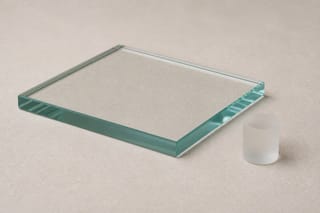
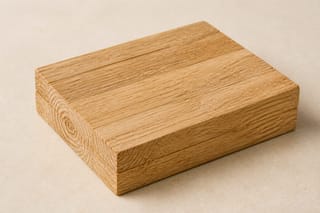
Material pair
How to Glue Glass to Wood
Use 2-part epoxy (clear) for most glass-to-wood joints. It bonds to surfaces wood glue cannot, and fills a gap instead of shrinking into one — the reason to reach past PVA on a loose joint or a mixed-material one.
Best Adhesive for Glass to Wood
It bonds to surfaces wood glue cannot, and fills a gap instead of shrinking into one — the reason to reach past PVA on a loose joint or a mixed-material one.
Derived from our material compatibility data.
Why 2-part epoxy (clear) Works
- Non-porous and unforgiving — any grease film or fingerprint weakens the joint and stays visible through the glass forever.
- Porous and slightly forgiving — glue soaks in, and a well-glued joint ends up stronger than the wood around it. Oily hardwoods like teak need a solvent wipe first.
- Cures clear and rigid, and stays waterproof.
- It bonds to surfaces wood glue cannot, and fills a gap instead of shrinking into one — the reason to reach past PVA on a loose joint or a mixed-material one.
Conditions
When to Use Silicone Instead
Alternatives
Other Adhesives That Work
Only for hanging a mirror or glass panel on a wall, and only with a mirror-rated tube — ordinary solvent formulas eat the silver backing.
Better when: Gap or poor fit
The right answer when the joint gets wet or has to move — it stays flexible for decades.
Better when: Flexing or movement, Water immersion
Products
Products for Bonding Glass to Wood
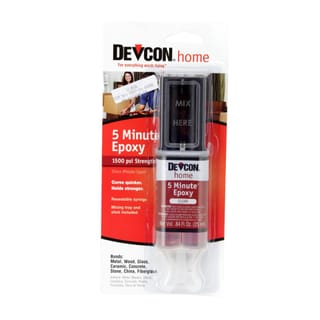
- Devcon 5 Minute EpoxyRapid, crystal-clear bonding on metal, glass, ceramic, wood, and rigid plastics — the benchmark fast-curing 2-part epoxy for jewelry, fine craft, and clean household break repairs.
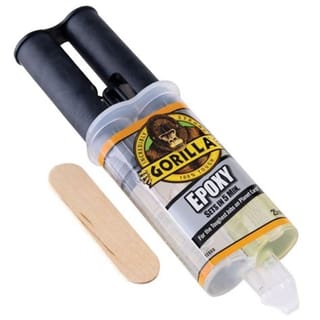
- Gorilla 2-Part EpoxyGeneral household rigid repairs where a clear, gap-tolerant bond matters.
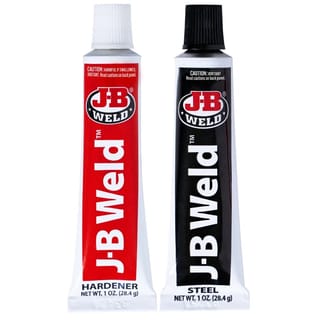
- J-B Weld OriginalRigid metal repairs — a cracked bracket, a stripped hole, a broken tool handle.
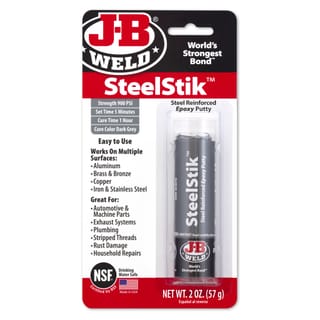
- J-B Weld SteelStik Epoxy PuttyHand-kneadable, non-rusting steel-reinforced epoxy putty for emergency plumbing repairs, auto components, stripped metal threads, and rebuilding missing metal/machinery sections — sets in 5 minutes and fully cures in 1 hour with 4,000 psi tensile strength.
Questions
Common Questions About Gluing Glass to Wood
- Can you glue glass to wood?
- Yes on clean glass and a flat, bare wood seat — the same if wood is going onto glass. Clear 2-part epoxy is the usual rigid pad; a long continuous glue line can crack the glass when the wood moves.
- Does wood glue stick to glass?
- No. PVA needs porous wood fibers. Glass has none, so the bond peels off the glass face even when the wood side looks fine.
- Can glue alone hold a glass top on wood?
- Not overhead, and not when a fall could injure someone. Use clips, a frame, or a ledge; adhesive can locate and cushion the glass if the retainer still holds.
- Will humidity crack glass glued to wood?
- It can. Wood changes size with moisture while glass does not. Use separated pads or a flexible adhesive such as silicone instead of locking a long glass edge to moving wood with one rigid line.