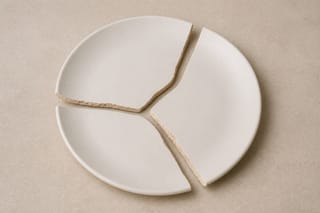
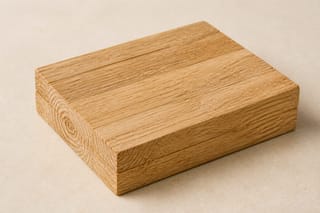
Material pair
How to Glue Ceramic to Wood
Use 2-part epoxy for most ceramic-to-wood joints. Bonds a fitted ceramic piece to bare wood without relying on wood porosity alone.
Best Adhesive for Ceramic to Wood
Bonds a fitted ceramic piece to bare wood without relying on wood porosity alone.
Reviewed and adjusted by an editor.
Why 2-part epoxy Works
- A clean break fits back like a puzzle with almost no gap — ideal for thin glue lines. Unglazed faces are porous; glazed faces are not.
- Porous and slightly forgiving — glue soaks in, and a well-glued joint ends up stronger than the wood around it. Oily hardwoods like teak need a solvent wipe first.
- Fills the tiny gaps in a clean break and survives hot water.
- It bonds to surfaces wood glue cannot, and fills a gap instead of shrinking into one — the reason to reach past PVA on a loose joint or a mixed-material one.
Conditions
When to Use Silicone Instead
Use Silicone
Use Polyurethane
Use Silicone
Epoxy is for a fitted, stable piece. A thick construction adhesive makes more sense for tile or a fixture on an uneven wall, while outdoor exposure favors polyurethane and movement or immersion favors silicone. None of those choices replaces mechanical support for a heavy overhead piece.
Alternatives
Other Adhesives That Work
The thick-bead option for tile or a fixture against an uneven hidden seat.
Better when: Gap or poor fit
A weather-tolerant option for an unglazed, clamped joint where squeeze-out can be hidden.
Better when: Outdoor exposure
A flexible sealing bond where the materials move or remain wet.
Better when: Flexing or movement, Water immersion
Products
Products for Bonding Ceramic to Wood
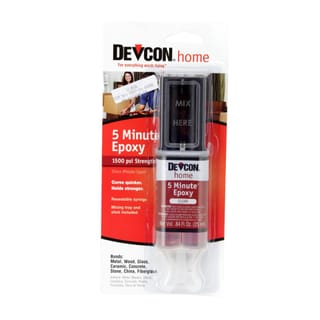
- Devcon 5 Minute EpoxyRapid, crystal-clear bonding on metal, glass, ceramic, wood, and rigid plastics — the benchmark fast-curing 2-part epoxy for jewelry, fine craft, and clean household break repairs.
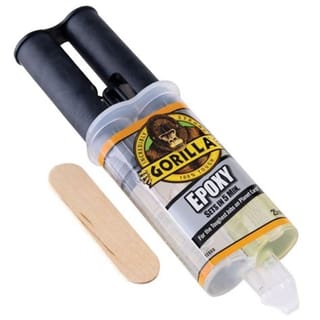
- Gorilla 2-Part EpoxyGeneral household rigid repairs where a clear, gap-tolerant bond matters.
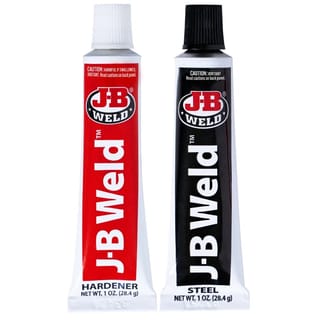
- J-B Weld OriginalRigid metal repairs — a cracked bracket, a stripped hole, a broken tool handle.
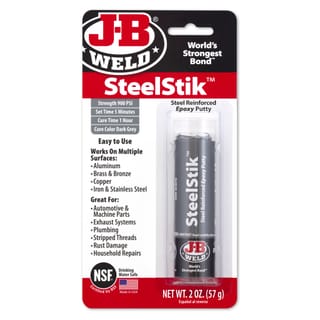
- J-B Weld SteelStik Epoxy PuttyHand-kneadable, non-rusting steel-reinforced epoxy putty for emergency plumbing repairs, auto components, stripped metal threads, and rebuilding missing metal/machinery sections — sets in 5 minutes and fully cures in 1 hour with 4,000 psi tensile strength.
Questions
Common Questions About Gluing Ceramic to Wood
- Can you glue ceramic to wood?
- Yes, on a flat, bare wood seat and a clean ceramic back — the same if a wooden piece is going onto ceramic. 2-part epoxy is the fitted indoor joint; a gap or outdoor exposure changes the pick.
- Does wood glue stick ceramic to wood?
- Not on the ceramic face. PVA needs porous wood fibers on both sides. Glaze and biscuit are not grain, so the bond peels off the ceramic.
- Can glue alone hold a heavy ceramic piece on wood?
- Not overhead, and not when a fall could injure someone. Bed the piece in adhesive, but give it a mechanical support that still holds if the bond weakens.
- Will wood movement crack a ceramic glue joint?
- It can. Wood changes size with moisture while ceramic does not. Keep long rigid glue lines short, and switch to silicone or polyurethane when the joint will stay wet or move.