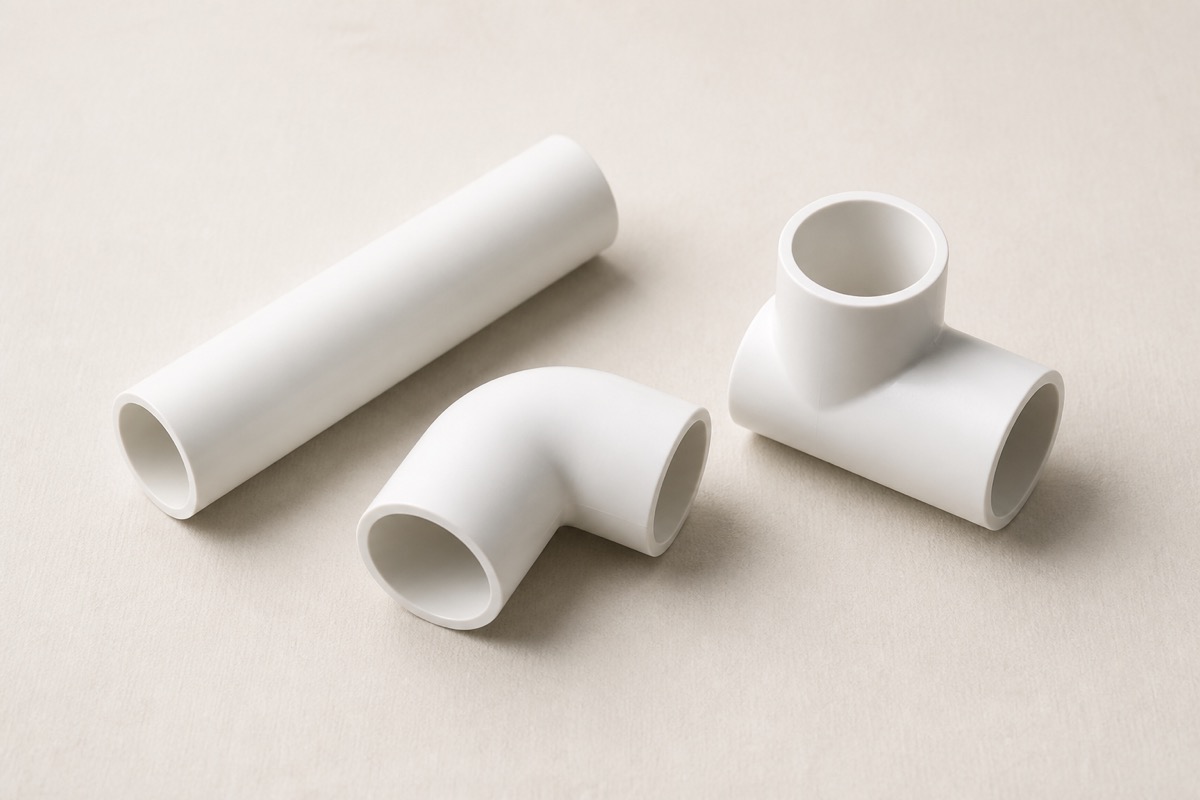
Best bet
It softens both faces so the fitting and the pipe finish as a single piece — the only joint that holds pressure.
Extra prep
- Cut square, deburr, and wipe both faces clean. Use the primer your plumbing code calls for, then push the joint fully home and hold it — a fitting can back itself out while the plastic is soft.
Not for: Gap or poor fit
Reviewed and adjusted by an editor.
Why this answer
- The one common household plastic with a purpose-made welding solvent, and that changes the whole answer: for pipe, fittings, and any joint that has to hold pressure, PVC cement is not one option among several, it is the joint. Ordinary adhesives are for the cases cement cannot cover — bonding PVC to something that is not PVC, or closing a gap where the two faces do not meet.
- It softens both faces so the fitting and the pipe finish as a single piece — the only joint that holds pressure, and the strongest one on rigid PVC generally. It welds a seam, so it cannot rescue a gap.
- Cut square, deburr, and wipe both faces clean. Use the primer your plumbing code calls for, then push the joint fully home and hold it — a fitting can back itself out while the plastic is soft.
How to do it
Step by step
- Cut the pipe square and deburr inside and out so the fitting can seat fully.
- Dry-fit — the pipe should go home without a gap; solvent cement cannot fill one.
- Wipe both faces clean and apply the primer your plumbing code calls for.
- Coat both faces with PVC cement, push the joint fully home, and hold it so the fitting cannot back out.
- Leave the joint undisturbed until the cement has developed strength — do not pressure-test until the product instructions allow it.
Conditions
When the answer changes
A cracked pipe or a joint that will not close is epoxy or a replacement, not cement — the weld needs faces that touch. Pressure and potable-water work follow the pipe standard and the cement on the can, not a general-purpose glue.
Alternatives
What else works
The repair once cement is out: it fills a broken or badly fitting joint that a weld would leave hollow. It is not a pressure joint.
Better when: Gap or poor fit
Extra prep: Scuff the gloss off both faces and wipe away the dust and any pipe printing ink.
Avoid
What not to use
Avoid
Spray adhesive
Spray adhesive — a repositionable film, not a bond; it slides off smooth plastic under any load.
Avoid
Wood glue (PVA)
Wood glue — plastic has no pores for it to soak into, so it peels off in a sheet.
Questions
Common questions
- Can I join PVC pipe with ordinary glue instead of PVC cement?
- Not for a joint that has to hold water or pressure. PVC cement softens both faces so they finish as one piece. A general-purpose adhesive sits on the surface and is a repair at best, not a plumbing joint.
- Do I have to use primer with PVC cement?
- Follow the pipe standard and the cement can. Primer cleans the gloss off and starts softening the plastic; where the code or the product calls for it, skipping it is how a joint looks assembled and still leaks.
- Can solvent cement repair a cracked PVC pipe?
- No. Cement welds faces that already touch. A crack, a chip, or a fitting that will not close needs a replacement section, or a filled repair that is not treated as a pressure joint.
- Will PVC cement work on ABS or CPVC?
- Only a cement whose label names that plastic. PVC, CPVC, and ABS each have their own formula; the wrong can either does nothing or attacks the fitting.