Guide
Repair a cracked PP bumper
You cannot glue a polypropylene bumper the way you glue ABS. A small dry crack on a tab or flare can take a two-step plastic primer kit. A split in the bumper beam or a crack that opens when you flex the cover needs plastic welding — or a new cover. Ordinary epoxy peels off PP.
This task involves: Outdoor exposure, Flexing or movement
Best Glue for This Repair
Plastic bonding kit (primer + CA)
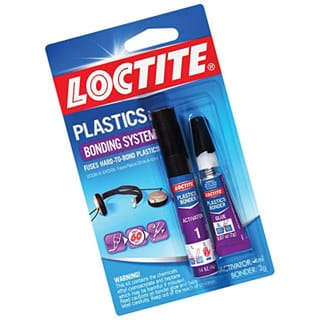
The activator pen raises PP's surface energy so the cyanoacrylate can grip a small, dry, close-fitting crack. Untreated PP sheds every ordinary glue.
Extra prep
- Wipe the surface clean, then coat both faces with the system's activator pen and let it flash off before the adhesive.
Not for: Outdoor exposure, Gap or poor fit
Reviewed and adjusted by an editor.
Why Plastic bonding kit (primer + CA) Works Here
- The problem plastic. Its waxy, low-energy surface sheds ordinary glues — epoxy, super glue, and wood glue all peel off. It needs a specialty primer system or a mechanical fix.
- The primer pre-treats PP's waxy surface so the adhesive can grip — ordinary glues can't.
- Wipe the surface clean, then coat both faces with the system's activator pen and let it flash off before the adhesive.
- The activator pen raises PP's surface energy so the cyanoacrylate can grip a small, dry, close-fitting crack. Untreated PP sheds every ordinary glue.
How to do it
Repair a cracked PP bumper: Step by Step
A glued bumper is not a crash repair
- Confirm the cover is PP — recycling code 5, waxy feel, a hot pin that melts rather than chars. If the crack is in a beam, a mount, or opens when you flex the cover, stop and weld or replace. Do not glue it.
- For a small dry crack on a tab, flare, or splash shield only: wash, dry, and scuff both faces. Wipe with isopropyl alcohol and let it flash.
- Coat both faces with the kit's primer pen, wait the time on the card, then apply the matching cyanoacrylate and hold the crack shut.
- Leave the part still until the kit's full cure. Do not flex the cover or wash the car early.
- A long split is a plastic-weld: heat and a PP welding rod, or a bumper shop. A rubber lip coming off the cover is contact cement, not this kit. If you can see daylight through a mount, do not drive on it.
Conditions
When to Use a Different Glue
Primer plus cyanoacrylate is only for a close-fitting dry crack. A bumper that has to survive another parking-lot hit is a weld. A rubber lip coming off the cover is a plastic-to-rubber job, not this crack repair. Do not drive on a glue-only structural repair.
Avoid
Glues to Avoid for This Repair
Avoid
2-part epoxy
Standard epoxy beads up on polypropylene and pops off the first time the cover flexes.
Questions
Common Questions About This Repair
- Does epoxy work on a cracked plastic bumper?
- Not on polypropylene. Standard epoxy beads up on PP and pops off when the cover flexes. Most modern bumper covers are PP (recycling code 5). Use a primer kit on a small dry crack, or weld a split.
- Can I drive after gluing a bumper crack?
- Only if the repair was a small cosmetic crack on a tab or flare and the kit has fully cured. A split in a mount or beam is a weld or a new cover. A glue-only structural patch can come off in traffic.
- The rubber strip came off the bumper — same glue?
- No. That is a plastic-to-rubber job. Use contact cement on both faces. The primer kit is for a crack in the PP cover, not a peeling rubber lip.
- How do I know the bumper is PP and not ABS?
- Look for recycling code 5, a waxy feel, and a hot pin that melts instead of charring. ABS is harder, often coded 7, and solvent cement can bite it. If acetone dulls the surface, this guide is the wrong one.