Tous les articles
Article
Époxy vs Super Glue (Cyanoacrylate) : quelle colle choisir ?
Comparatif direct entre les deux colles les plus populaires pour les réparations domestiques : forces, faiblesses et cas d'usage idéaux.
The core difference in 10 seconds
Most homeowners keep both Super Glue (cyanoacrylate) and 2-part epoxy in a utility drawer. While both are advertised as "super strong," they work completely differently:
- Super glue is water-thin and cures in 5 to 15 seconds by reacting with invisible moisture on surfaces. It has zero gap-filling ability — the two broken faces must touch with microscopic precision.
- 2-part epoxy consists of a resin and a hardener mixed in equal parts. It cures by internal chemical reaction, does not shrink, and hardens into a rigid solid plastic that fills holes, bridges missing chips, and holds heavy weight.
When to pick Super Glue
Reach for super glue when speed and a near-invisible glue line are all you need:
- Clean hairline cracks: A clean break where all broken pieces fit tightly together with zero missing slivers.
- Small, non-porous parts: Broken eyeglass nose pads, plastic toy limbs, decorative trinkets, and small jewelry.
- Rubber bonding: Super glue is exceptionally fast and strong on clean rubber O-rings, gaskets, and chair leg bumpers.
- When clamping is impossible: Because it sets in 10 seconds under light finger pressure, it works when you cannot attach a clamp.
When to pick 2-Part Epoxy
Reach for 2-part epoxy whenever the repair involves weight, gaps, water, or alignment time:
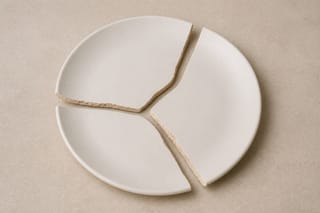
- Missing chips or uneven edges (gap-poor-fit): If tiny ceramic slivers crumbled away when an item broke, super glue will leave a hollow void that snaps instantly. Epoxy fills that gap completely.
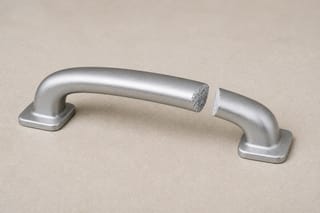
- Heavy leverage and shear loads: Mending a broken mug handle, a heavy tool handle, a metal bracket, or table legs.
- Water immersion and outdoor exposure: Cured epoxy is fully waterproof and shrugs off moisture, hand-washing, and humidity (see fix a broken ceramic mug).
- Complex multi-piece puzzles: Super glue gives you 5 seconds before it locks forever. 5-minute or 30-minute epoxy gives you generous working time to adjust and align multiple fragments into place.
The 30-second rule of thumb
Ask yourself three quick questions before opening a tube:
- Do the pieces snap back together seamlessly?
- Yes: Super glue.
- No (chipped or rough gap): Epoxy.
- Will someone pull, twist, or hang weight on it?
- Yes: Epoxy.
- No (decorative/static): Super glue.
- Will it be washed, soaked, or exposed to rain?
- Yes: Waterproof epoxy.
- No: Super glue.
Questions
Questions fréquentes
- Can I layer super glue to fill a missing chip in broken pottery?
- No. Thick beads of standard super glue take hours to cure, shrink significantly as they dry, and form a brittle, glassy core with weak shear resistance. Always use 2-part gap-filling epoxy or epoxy putty when pieces do not fit flush.
- Does adding baking soda to super glue make it act like epoxy?
- Sprinkling baking soda (sodium bicarbonate) over super glue instantly triggers polymerization, forming a hard acrylic cement in seconds. While great for rapid plastic reinforcement or filling holes, it is still more brittle than structural 2-part epoxy.
- Which glue has a longer shelf life after opening?
- 2-part epoxy lasts 2 to 5 years once opened because the resin and hardener remain separated in their individual tubes. Super glue reacts with ambient air moisture inside the bottle and typically dries out solid within 3 to 6 months after opening.
- Is epoxy or super glue safe for items washed in a hot dishwasher?
- Neither is completely dishwasher-safe for long-term repeated cycles. Hot dishwasher water (140°F/60°C+) and harsh alkaline detergents soften super glue and slowly degrade epoxy. Hand-washing in warm water is strongly recommended for all glued repairs.